- Home
- Days of Yore
- Video News
- Offbeat News
- Fun & Entertainment
- Serious About Food
- Crime & Punishment
- Sports & Recreation
- Acworth News
- Ball Ground News
- Canton News
- Holly Springs News
- Waleska News
- Woodstock News
- Sophisticado Lifestyle
- Cherokeet Connect
- Opinion of the young
- Funny pages
- Sponsors
- Weekly Spotlight
- Community Pulse
Offbeat News
Family Remembers Man Found Dead Inside Vacant Cobb County Kroger; Police Suspect Foul Play
COBB COUNTY, GA:
Family members are mourning the loss of a beloved son, brother, and uncle after a man was found dead inside a vacant former Kroger supermarket in Cobb County last week.
According to investigators, 43 year old James Connell was discovered deceased on May 21 inside the abandoned grocery store located along Cobb Parkway SE. The building has remained vacant since closing in 2024.
Authorities say a maintenance worker checking the property for a reported water leak made the grim discovery and contacted police.
The case remains under active investigation, and Cobb County Police have indicated that foul play is suspected in Connell’s death.
As detectives continue searching for answers, Connell’s family is remembering him for the impact he had on those around him.
In a statement released Wednesday, the family said:
“Our family’s hearts are heavy as we mourn the loss of a beloved son, brother, and uncle. James Connell was deeply loved by those who knew him. He was incredibly bright, generous, and compassionate, with a big heart that touched many lives. We respectfully request privacy for our family during this difficult time.”
The circumstances surrounding how Connell ended up inside the vacant building and the events leading up to his death have not yet been released by investigators.
The case has drawn attention from nearby residents, with many expressing concern as police continue their investigation into the suspicious death.
Anyone with information related to the case is encouraged to contact Cobb County Police.
Eye on Cherokee will continue to follow this developing story and provide updates as more information becomes available.
Offbeat News
Man found dead
Man Found Dead After Disappearing in Noonday Creek Over Memorial Day Weekend
A man who disappeared in Noonday Creek over the Memorial Day weekend has been found dead following an extensive search effort by Cobb County authorities.
According to police, officers responded to the creek just before 10 p.m. on May 24 after receiving reports that someone had entered the water and failed to resurface.
Investigators identified the man as 31 year old Otoniel Cruz. Authorities said Cruz had been spending time at the park with family and friends before the incident occurred.
Police said recent storms had caused water levels and currents in Noonday Creek to rise significantly, creating dangerous conditions in the water.
Investigators believe Cruz attempted to swim across the creek before disappearing underwater.
Multiple agencies, including Cobb County Fire personnel, the Cobb County Sheriff’s Office, and Cobb Police, launched a large-scale search operation using boats, drones, and thermal imaging equipment.
Officials confirmed Monday that Cruz’s body had been recovered.
The investigation remains ongoing.

Offbeat news
Metro Counties Decriminalize Marijuana While Cherokee County Holds the Line
As several major metro Atlanta counties shift their approach to marijuana enforcement, Cherokee County remains steadfast in its strict policy — even as legislators in Georgia consider broader statewide cannabis reform.
Over the past few years, Fulton County, DeKalb County, and Cobb County have adopted local ordinances that reduce criminal penalties for possession of small amounts of marijuana. In most cases, individuals found with under an ounce face civil fines rather than jail time. Supporters say the change allows law enforcement to focus resources on violent crime, opioid distribution, and trafficking of more dangerous narcotics.
In contrast, Cherokee County continues to enforce Georgia’s state marijuana laws without adopting a decriminalization ordinance. Under current state law, possession remains a criminal offense that can result in fines and possible jail time.
A Difference in Enforcement Philosophy
Advocates for reform argue that easing penalties for low-level marijuana possession would allow officers to prioritize combating fentanyl, methamphetamine, and other high-risk drugs that pose significant threats to public safety. They contend that reducing misdemeanor marijuana arrests could lessen strain on courts and detention facilities while redirecting manpower toward violent offenders and trafficking operations.
Opponents maintain that marijuana remains illegal under Georgia law and argue that consistent enforcement upholds public order and deters broader drug activity.
State-Level Reform Proposal: HB 1248
The debate has also reached the Georgia State Capitol with the introduction of the Georgia Cannabis Freedom and Integrity Act (HB 1248).
The proposed legislation would:
• Legalize possession of up to two ounces of cannabis for adults
• Allow home cultivation of up to three plants for personal use
• Establish a state regulatory commission to oversee licensing, taxation, and enforcement
Supporters of HB 1248 argue that a regulated framework could shrink the illicit market and enable law enforcement agencies to focus more aggressively on dangerous drugs and criminal enterprises rather than small-scale marijuana possession. Critics raise concerns about public health, impairment, and regulatory challenges.
The bill remains under consideration.
A Historical Note on Hemp
Discussions about cannabis often include distinctions between marijuana and hemp. Hemp — a variety of cannabis cultivated for fiber, rope, and textiles has deep roots in early American agriculture.
George Washington is historically documented as having grown hemp at Mount Vernon in the 18th century. At the time, hemp was a valuable crop used to produce rope, sails, and other essential materials for the young nation. While hemp cultivation was common among colonial farmers, it is important to note that industrial hemp differs in THC content from modern marijuana varieties grown for intoxicating effects.
Looking Ahead
As neighboring counties adjust enforcement strategies and state lawmakers debate broader reform, Cherokee County continues its current approach aligned strictly with Georgia law.
The question facing residents and policymakers alike is whether enforcement priorities should remain unchanged or evolve alongside shifting policies in surrounding metro counties. With HB 1248 under discussion, Georgia’s cannabis policy conversation appears far from over.

Metro Counties Decriminalize Marijuana While Cherokee County Holds the Line
Local Man Attempts DIY Wildlife Rescue
Apparently he is not a Disney Princess
Local Man Attempts DIY Wildlife Rescue, Accidentally Invents Worst Possible Carpool Buddy
ROSWELL / CHEROKEE COUNTY — An incident earlier this week at the Chattahoochee Nature Center (CNC) has left wildlife officials equal parts concerned, baffled, and quietly clutching their rabies vaccination records.
According to CNC staff, a well-meaning Cherokee County gentleman—whose name we still do not know for reasons that will soon become obvious—came across an injured raccoon vocalizing in the road. This, experts note, was the story’s first red flag, as wild raccoons are famously quiet unless auditioning for the role of “Predator Bait No. 1.”
Lacking a crate, carrier, box, bucket, or even a Publix bag, the man decided the safest place for a distressed wild mammal would be inside his coat, pressed lovingly against his chest, for what became a one-hour mobile snuggle session all the way to CNC.
Shockingly, the raccoon disagreed.
During the drive, the animal freed its head and promptly demonstrated the CDC-approved definition of “bad idea” by biting the man on his face and hands. In response, the man drove home, wrapped the raccoon in a blanket, secured it with duct tape (because of course he did), and resumed the trek to CNC.
He arrived an hour before the Wildlife Clinic opened—coinciding perfectly with the arrival of children attending CNC’s Camp Kingfisher. The Camp Director, showing excellent reflexes, immediately radioed Wildlife staff to inform them that a man holding a mystery duct-taped bundle was approaching in the parking lot.
Wildlife staff met the man with a kennel, strong professional composure, and—after more persuasion than one would expect—finally convinced him to go to the hospital for treatment. This turned out to be important, since:
The raccoon later tested positive for rabies.
Within 48 hours, CNC was notified that the animal carried the virus known for having a >99% fatality rate if untreated. Meanwhile, CNC was still trying to determine the man’s identity because he had refused to give staff or the hospital his full name and even provided a fake phone number. (A family member later called CNC, presumably saying something like, “Hi, I think you met my brother? He’s the one with the duct-taped raccoon?”)
Thanks to rapid coordination between CNC, Bells Ferry Veterinary Hospital, the Cherokee County Health Department, and the Georgia Wildlife Network, the raccoon was safely handled and submitted for testing—while a small army of professionals held their breath waiting for the results.

Rabies!
Gasoline in the stratosphere
Welcome to Eye On Cherokee - Your Ultimate Source of Mass Media News
🚨 Local News: My 3 Way Grocery Takes Crime Prevention to New Heights — Literally 🚀
By Eye on Cherokee Staff Writer Salvatore Insinga.
CHEROKEE COUNTY, GA — The beloved roadside stop known as My 3 Way Grocery located on Bells Ferry rd in Woodstock has long been a community favorite, not just for its world class soda selection (locals swear it’s “better than a convenience store should legally allow”) and in-store pizzeria that could rival downtown eateries — but now, it’s gaining fame for a much more elevated reason.
This week, the owners of My 3 Way Grocery unveiled what they’re calling “the most advanced anti-theft system in the Southeast” — a massive hot air balloon tethered to the roof of the gas station.
According to the store manager, the idea came after a string of petty thefts and gas drive-offs have befouled the greater Atlanta area. “We were tired of chasing folks down Highway 92,” Dobbins said. “So we figured, if we can’t stop crime on the ground… we’ll just leave the ground.”
Here’s how it allegedly works:
In the event of a robbery, a silent alarm automatically ignites the helium boosters (the store insists it’s “FAA-compliant-ish”), lifting the entire building, pumps, pizza oven, and all rises up to 15,000 feet in the air.
The thief, trapped mid-crime, is left hovering in the clouds until authorities arrive. “It’s hard to make a getaway when you’re looking down at Canton from the stratosphere”.
Residents have mixed feelings about the innovation. Local teacher Linda Pearman called it “the dumbest and most brilliant thing I’ve ever seen”. Still, the public response has been overwhelmingly positive not just for the spectacle, but for the snacks. “You can’t beat a cold Mountain Dew, a slice of pepperoni, and a view from 15,000 feet,” said customer Tucker Bell, munching happily at the checkout counter.
For now, the My 3 Way Grocery balloon can be seen from miles away, a bright orange and yellow bobbing reminder that in Cherokee County, crime doesn’t pay — it ascends.

Anti theft balloon deployed
Where was Virgil?
Wrestling Legend Ted DiBiase Injured in Tumble at Atlanta Airport
Wrestling Legend Ted DiBiase Injured in Tumble at Atlanta Airport
Atlanta, GA – September 11, 2025
Wrestling Hall of Famer and former WWF superstar Ted “The Million Dollar Man” DiBiase was briefly sidelined this week after an unexpected incident at Hartsfield–Jackson Atlanta International Airport.
According to bystanders, DiBiase tripped over a small child near a crowded gate area, falling hard and injuring his ribs and face. Witnesses described the moment with a mix of shock and humor.
“The kid put the Million Dollar Man flat on his ass,” one traveler said, adding that DiBiase “looked ready to lock in the Million Dollar Dream before he realized what had happened.”
Fortunately, the child was not injured. Fans noted that longtime manager and bodyguard Virgil was nowhere in sight to provide backup.
Airport officials confirmed that no charges have been filed in the incident, and it is being considered an accident.
DiBiase, 71, is said to be recovering at home and in good spirits despite the bruises.
The Million Dollar Man, famous for his catchphrase “Everybody’s got a price!”, now has a new story to add to his legacy—though this time, it was gravity and a pint-sized traveler that got the best of him.
Where was Virgil?
The big Ai bust
Welcome to Eye On Cherokee - Your Exclusive Destination for Mass Media Insights
Police Called On Artist Accused of Selling A.I. Art at Dragon Con
By Salvatore Insinga| Published Mon, Sep 1, 2025 | Atlanta, GA
Police were called to Dragon Con in Atlanta this past weekend after a vendor was accused of selling artificial intelligence–generated artwork under the guise of their own creations.
The artist, exhibiting under the name Oriana Gerez, was stationed at booth A10 when complaints from fellow vendors and attendees prompted staff to intervene. Security, followed by police, asked Gerez to pack up and leave the convention floor.
Photos and videos of the incident, shared widely across Facebook, Instagram, BlueSky, and X, show officers standing by as the vendor dismantled their booth. Illustrator Dane of Monkey Minion—a regular at conventions—posted images of the aftermath, which quickly went viral in art and fan communities.
Social Media Backlash
The controversy only escalated after Gerez allegedly posted a defiant message online:
“I’d share a screenshot of my sales this weekend but don’t have to give any explanations to you losers. You guys are sore because you don’t sell sht and will be forever broke. Have fun being a broke bitch.”*
The Instagram account linked to the artist has since been set to private, and their personal website has been scrubbed of several pieces that critics flagged as A.I.-generated.
No Clear Policy
Dragon Con, one of the largest fan conventions in the United States, has no clearly stated policy on using others art without permission, every year many vendors sell art and products not licensed by their intellectual property owners, what makes this incident different is the removal mid show from the artists gallery at dragon con.

Ai artist busted at Atlanta Dragon-con
Tight Senate Battle
Trump Love Test Defines Tight Senate Battle in Cherokee County
Trump Love Test Defines Tight Senate Battle in Cherokee County
Cherokee County, GA – The Republican primary for Georgia’s State Senate District 21 has turned into a bizarre contest of one-upmanship, as two nearly indistinguishable candidates, Jason Dickerson and Steve West, fight for the conservative heart of Cherokee County.
Both men, middle-aged white conservatives who could be mistaken for twins if not for West’s neatly groomed beard, are running on virtually identical platforms: slow down development, lower taxes, and pledge undying loyalty to President Donald Trump.
But in a county where every candidate vows to love Trump and cut taxes, the race has boiled down to two surreal questions: Who loves Trump more? And who can lower taxes so much that the government actually pays citizens just for living in Cherokee?
“Jason Dickerson may not have a beard, but he has something better—an absolute, unshakable devotion to Donald Trump,” declared one supporter outside a local gas station, waving a flag that simply read ‘MAGA Forever’.
Not to be outdone, a crowd at a barbecue restaurant said, “Steve don’t just love Trump. He really loves Trump. Others say whomever is more conservative should win, so tax will go so low the county will be mailing you a check every Friday just for existing.”
Political analysts say the race has devolved into a “Trump-love-off,” where each man is forced to outdo the other in public displays of MAGA devotion. At a recent debate, a candidate promised to rename all local schools after Trump family members, while the other vowed to replace the county seal with Trump’s face.
Despite the circus, voters remain divided. “They’re exactly the same guy,” one resident shrugged. “But Steve’s got that beard, and beards mean wisdom. On the other hand, Jason looks like he’d fit right in on Fox News.”
With polls showing the candidates neck and neck, the only certainty is that the winner will be the one who convinces Cherokee County he is Trump’s truest disciple. As one local put it, “We don’t need a senator—we need a Trump worship leader.
The Republican primary is scheduled for later this year, but in Cherokee County, the decision may ultimately come down to which candidate can shout ‘I love Trump!’ the loudest.
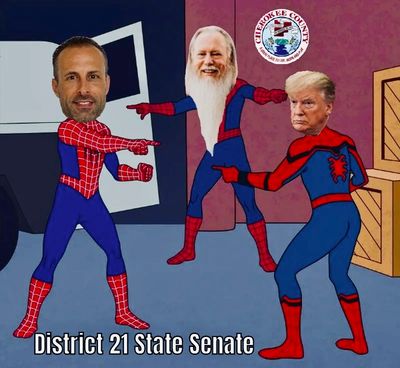
Steve West Vs Jason Dickerson
Chaos on the lake could lead to more security measures
Subs on the lake!
Lake Allatoona Chaos Sparks Sheriff’s Plan for Submarine Patrols
Cherokee County, GA — July 21, 2025
Lake Allatoona, once known for its serene fishing spots and lazy summer afternoons, has taken a turn toward chaos this season as reckless teens turn it into what some are calling “Georgia’s new aquatic Wild West.”
With an alarming rise in dangerous behavior — from high-speed jet ski drag races to groups of teenagers refusing to wear life jackets — the Cherokee County Sheriff’s Department may have had enough. Multiple near-collisions, noise complaints, and viral TikTok videos showing “jet ski jousting” have prompted the department to consider an unprecedented solution: military-grade submarines.
“We’re exploring every option,” said a representative. “If they want to play like it’s a war zone, we’ll patrol like it is one.”
The department has reportedly opened discussions with federal surplus suppliers to obtain up to three decommissioned, compact submarines previously used for coastal surveillance. The submarines would be modified for shallow water operation, equipped with sonar, underwater loudspeakers, and a specialized fining system capable of scanning boat registration numbers from below.
“Look, this isn’t Red October,” said the lake warden. “But we’re not going to sit by while these kids treat the lake like it’s a Daytona 500 for watercraft. Someone’s going to get hurt, and we’d rather look ridiculous now than be sorry later.”
Local reactions have been mixed.
“Submarines? Really? This is Lake Allatoona, not the Atlantic,” said longtime lakefront resident Linda McGrath. “But honestly, if it keeps these maniacs from running over my kayak, I’m all for it.”
Teens, meanwhile, have taken to social media to mock the proposal, dubbing it “Call of Duty: Jet Ski Ops.” Hashtags like #SubmarineSummer and #HideFromTheSheriff have trended locally.
According to the lake warden, the submarines would not carry weapons, but would serve primarily as deterrents and mobile command units during busy weekends. Deputies would be trained in basic submersible operations and underwater communication, with an emphasis on identifying unregistered or dangerously operated vessels.
Critics argue the money could be better spent on increased shoreline patrols, more life jacket giveaways, or a teen education campaign. But department leadership stands firm.
“Every summer, we warn people. Every summer, someone ends up in the ER or worse. This year, we’re surfacing from below — literally.”
Until the submarines arrive — if they ever do — the sheriff’s department is probably increasing boat patrols.
Whether underwater enforcement becomes reality or remains lake lore, one thing is clear: this summer, Lake Allatoona is making waves in more ways than one.
Lake Allatoona Chaos Sparks Sheriff’s Plan for Submarine Patrols
Cherokee County, GA — July 21, 2025
The last true Pied Piper
The prophecy has come true
WOODSTOCK, GA — June 30, 2025
A Lone Hobo Plans 4th of July Protest Parade for Frightened Animals in Cherokee County
Behind the bustling Walmart off Highway 92 in Cherokee County, a soft-spoken man known simply as “Piper” has been living quietly with his pack of rescued strays — dogs, cats, and even a squirrel he calls “Lieutenant Whiskers.” But this Fourth of July, he’s stepping out of the shadows to speak for those who can’t.
Piper, who locals often see strolling with his flute and a trail of loyal animals, says he’s heartbroken by how the community overlooks the toll fireworks take on animals — both wild and domestic. “I don’t hate celebration,” he told us, “but I hate the fear it causes. Every pop and bang turns these sweet souls into shaking ghosts.”
In a one-man mission for change, Piper is organizing what he calls a “March of the Muzzled” — a peaceful, early morning protest set to begin at dawn on July 4th, walking down Main Street in Woodstock. All animals — dogs, cats, horses, birds, goats, or “whatever critters need a voice” — are invited to attend with their humans.
Piper says he chose dawn not just for the symbolism — a new day, a better way — but also because it’s a time when animals feel safest. “They deserve one moment of peace before the skies explode,” he says. “Let’s give them that.”
The county has not yet issued a statement on the protest. Denizens have confirmed that as long as the march remains peaceful and doesn’t obstruct traffic, Piper and his “parade of paws” will be allowed to proceed.
Still, reactions in the community are mixed. Some residents online have voiced support, saying Piper’s cause sheds light on a real problem. Others have called it “ridiculous,” defending fireworks as a tradition too important to give up.
Piper, undeterred, simply asks people to think twice. “Freedom means nothing if we ignore the suffering it causes others — especially the voiceless.”
The March of the Muzzled begins July 4th at 5:45 AM near the Woodstock gazebo and will proceed quietly down Main Street. Piper encourages anyone who wishes to walk — two legs or four — to bring a sign, a leash, and a little compassion.
Contact Info:
For more information or to support Piper’s animal safety efforts, email marchofthemuzzled@gmail.com or simply follow the music at dawn.
Article by, Salvatore Insinga
Pied Piper to march in Woodstock GA
Dog Grooming has become a symbol of style

Fashion from the dog park!
Have you seen some of the latest fashions and grooming on the dogs at Cherokee County's many dog parks? Our world-class dog parks are filled with excited, well-groomed dogs. What do you think of some of these hybrid dogs? We would love to feature your gorgeous pooch! Please email photos of your dogs to us at eyeoncherokee@gmail.com.

Woodstock 1900 Street Festival
Folks in Cherokee County have been coming to town for fun and food for over a hundred years, as seen in the photo. This is a shot of a festival in Woodstock in 1900, just over 60 years after it was founded. How do you think the traffic was back then?
Lake Acworth Flea Market
The Lake Acworth Flea Market is a bizarre filled with everything and anything. Inventory is new every weekend as new dealers and seasoned pickers bring their perspective wares to be sold at the market every weekend. This is a true flea marketers flea market no frills and filled with inexpensive treasure. the dealers are as colorful as their wares and are ready to haggle on that special item you want. the flea market is only open on weekends starting at 9 and the pickers are ready to pounce as soon as it opens. this place is a fun quirky flea market.
Day of the dead bandit caught at Nuevos Amigos
Day of the dead bandit caught at Nuevos Amigos Cocina Mexicana
Canton, GA
Dia de los Muertos 2022 was upon us and in Cherokee County, Mexican food is a big deal. Our county is filled with Mexican food gormandizers. Dianne, owner and chef of Nuevos Amigos Cocina Mexicana on Sixes Road in Canton, is obviously an owner who is passionate about her restaurant's aesthetic and artistic flair. There is no gimcrack on Dianne’s walls and the restaurant, inside and out, is stylish and clean. In celebration of Day of the Dead 2022, Nuevos Amigos decided to adorn their entry with flowers, including lovely potted mums.
Patrons came and ate, having a fun time and enjoying the ambiance and vibe of the restaurant. Sadly after the celebration concluded, someone noticed one of the mums was missing. Dianne runs a successful business and does not seem to miss details, from her cuisine to the edge of the parking lot. When Dianne and her management discovered the mum was missing, they watched the camera footage to see what happened. The footage revealed a flax colored, tattooed woman absquatulating with the potted plant. Only one thing wrong in this scenario: the woman and her older, silver-haired cohort had just eaten inside and paid with her credit card.
The restaurant then searched the woman's name on social media and found the bandit. To their surprise, they saw the woman not only had the mum but had posted in several online posts, bragging about her new plant. Authorities were notified and the woman was charged with theft by taking.
Nuevos Amigos welcomes photography around their restaurant, garden and stages, but the decorations are certainly not souvenirs.
by Salvatore Insinga

Day of the dead bandit caught at Nuevos Amigos Cocina Mexicana!
Extra Ranch please.

Has anyone else noticed the uptick of cowboy hats donning the heads of Cherokeeans in our county? It could be in part to the new Paramount Network show Yellowstone which just wrapped up its 4th season.
The show's creator Taylor Sheridan confirms that season five has been written and says they will begin filming in May 2022, with the first episode expected to air in the fall of 2022.
We must say, Rip looks awfully cool in his cowboy hat. We see quite a few fellas are starting to cowboy it up around town.
Sheriff Reynolds warns us to be weary of door to door pine straw sales

A message from our Sheriff:
"Please be wary of ANYONE who shows up at your home uninvited and attempts to sell you pine straw. Often they will spread the pine straw and then charge formore bales than they actually put out, or put out more bales than requested and/or change the price. No permits have been issued to anyone in Cherokee County this year allowing people to sell pine straw door to door.
If you ever feel someone is trying to scam you at your home please call 911 immediately and we will send a deputy to your residence."
Sheriff Reynolds says to further spread the word to our elderly neighbors who may not see warnings on social media and online news.
Scam Alert, The fast food dining room accident victim.
Multiple residents have reported that their families have been approached by a bruised faced woman in her 70’s. The unknown woman claims that both she and her husband were in a bad car accident and he was just transferred to a burn unit in Augusta. She claims that she has found a way to Augusta, but needs your help with gas money.
The bizarre part is residents claim to have heard the same story from this same woman for the past six years and also report they have seen the same bruise for six years as well.
Remember, if you ever feel threatened or uneasy in any situation, we recommend calling 911. Cherokee County Law Enforcement takes protecting its citizens very seriously.
Fake Violin Scam
One of our readers sent us this warning about a recurring local scam:
"About a week ago, I noticed in the parking lot of a grocery store a child playing an electric violin, and the child's "mother" holding up a sign that they lost their job due to Covid, and their son is helping earn money by using his talents.
It looked very convincing until I started watching, and realized he wasn't playing exactly what was coming out of the PA. He had good technique, and was "playing" the right notes, but most of the embellishments (slides, grace notes, trills, etc.) were not being pantomimed on the instrument. Recently I heard from a friend in another state that he saw the same thing in his local grocery store parking lot. He's watching management kick him out (they're busking on private property without permission). He's a pro violinist and noticed the same exact thing--these guys aren't playing.
Is this a new trend? Fake playing electric violins for tips?"
What do you think readers? Send us your thoughts to eyeoncherokee@gmail.com.
Neca Toys ambassador at target = free gift card drawings

Legendary toymaker Neca Toys has teamed up with Target to create a nationwide ambassador program. To apply for ambassadorship of your local Target, simply visit the store, straighten up the Neca toy section, and take a picture of your handiwork to submit to Neca. If you are selected, then once a week, go back to the store, straighten up the Neca toy section and submit another picture, and you are entered into a low pool drawing for $20 in potential Target gift cards. And, once a month you have a chance to win $100. Seems like a fun and easy way to win cash. You can only claim one store and Eye on Cherokee has claimed the Woodstock 92 location. Any wins will be donated to a local charity. If you move quickly, the surrounding Target stores are open to claim. We've included a link to the official rules as well.
Display their FAQs

Customers have questions, you have answers. Display the most frequently asked questions, so everybody benefits.